Independent & US-focused
Bifacial solar, explained without the hype.
Guides and a free calculator that tell you where a panel's rear side actually adds energy — and where it barely moves the needle. No invented prices, no fake reviews.
- Free
- calculator, no sign-up
- Honest
- ranges, not hype
- US-focused
- guides & gear criteria
Free calculator
See a realistic gain range in seconds
Enter your system size, mounting type, and the surface behind your panels. We estimate daily and monthly kWh and a conservative bifacial gain range — always shown as a range, never a single inflated number.
Daily energy
3.0–3.2
est. kWh / day
Est. gain range
8–16%
vs monofacial
Example: an 800 W ground-mount array over white gravel at 4.5 sun hours/day. Your numbers will differ — that's the point of the tool.
Where it fits
Bifacial by use case
The honest version: rear-side gain depends almost entirely on how the panel is mounted and what's behind it.
Ground-mount
Where bifacial is strongest: panels tilted above open, reflective ground with clear sky behind them.
Read the guideFarm & agrivoltaic
Elevated rows over crops or gravel can capture meaningful rear-side light across the day.
Carport
Elevated structures with bright surfaces below can see real gain; dark asphalt limits it.
Off-grid cabin
Works well on a ground array; gain is modest if panels are flush to a roof with no rear light.
Read the guideRV & portable
Be realistic: flat roof-mounted panels block the rear face, so gain is often small. Portable, tilted setups do better.
Read the guideBifacial vs monofacial
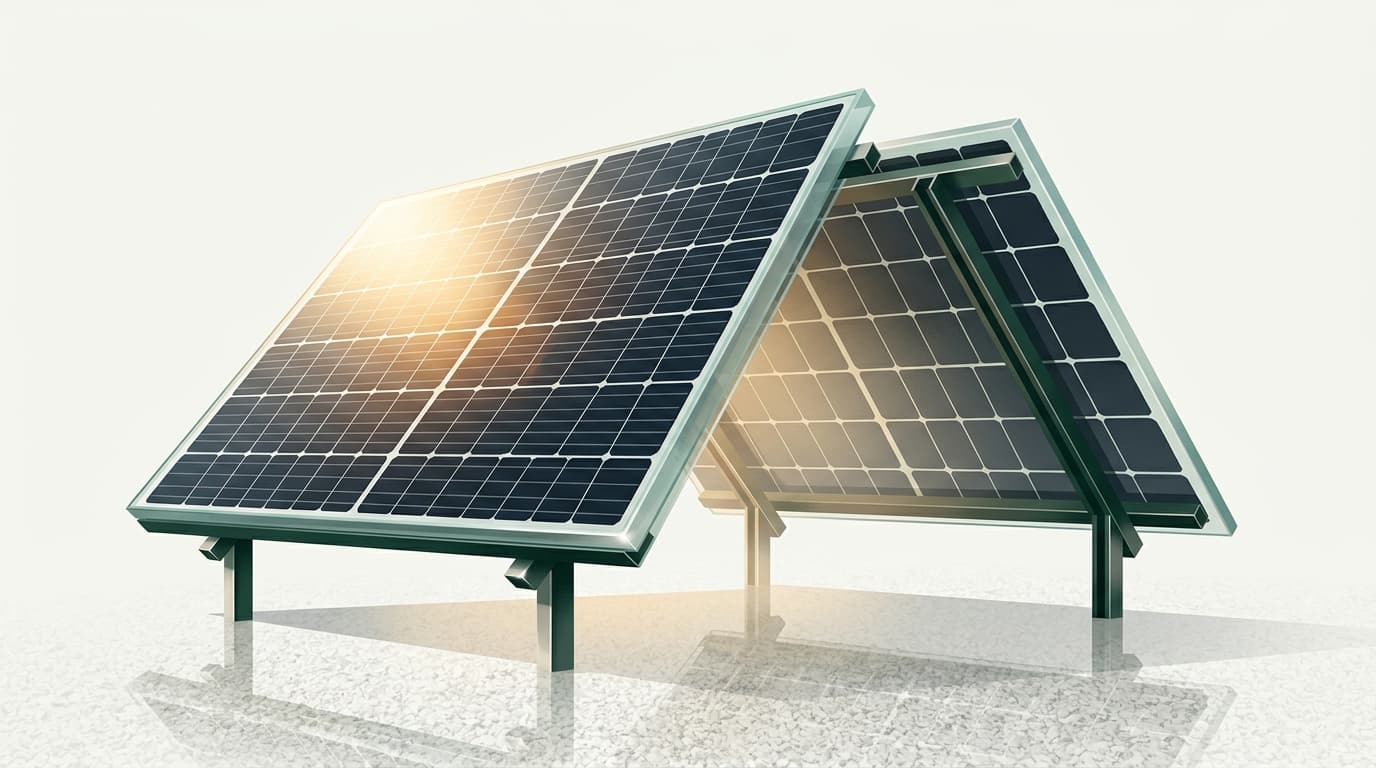
Monofacial panels collect light on one face. Bifacial panels add a glass rear that captures reflected light — useful only when light can actually reach it.
What to look for
Gear that makes bifacial work
We're an independent guide, not a store. Until we've connected verified retailers, we point you to the categories that matter — not invented product picks.
We're an independent guide with no active affiliate partnerships right now. If we add them, affiliate links will be clearly marked — and they'll never affect our recommendations. Full disclosure.
Bifacial panels
Dual-glass modules that also generate from light reflected onto the rear face.
Solar kits
Bundled panels, charge control, and wiring — a simpler starting point for off-grid builds.
Batteries
Storage (typically LiFePO4) to hold energy for nights, cabins, and RVs.
Inverters
Convert DC from the panels to usable AC for your loads.
Mounting hardware
Racks, tilt legs, and ground mounts — the part that actually unlocks rear-side gain.
Questions
Bifacial solar FAQ
Are bifacial panels worth it?
How much more do bifacial panels produce?
Do you sell panels?
Start with a realistic estimate
Two minutes, no sign-up. See whether bifacial makes sense for your specific setup.